
If your building needs an occupancy permit, you must maintain its essential safety measures so they operate properly, keep evidence of that maintenance, and lodge an annual report on time. If your logbook has gaps or maintenance is overdue, sort it now, cross-check the occupancy permit against Schedule 8 of the Building Regulations 2018, and align your testing regime with AS 1851-2012.
TL;DR:
- Owners must ensure all essential safety measures are properly maintained, tested, and documented annually to avoid escalation to orders or prosecution.
- Compliance hinges on up-to-date records, including inspection reports, contractor licenses, and defect rectifications, with clear proof of ongoing maintenance.
- From February 2026, NSW mandates referencing AS 1851-2012 for most fire safety testing, requiring owners to verify contractor competency and overdue intervals.
- Regularly reviewing and reconciling maintenance schedules with the occupancy permit can prevent gaps, especially for long-interval items like fire pumps and alarms.
- Using specialized contractors to coordinate testing and maintain records reduces the risk of non-compliance and simplifies the audit process.
Table of Contents
- What counts as an essential safety measure?
- Who's legally responsible, and what happens if you're not compliant?
- Annual reporting: AESMR in Victoria, AFSS in NSW
- Maintenance schedules and AS 1851: what's changing in NSW
- What records you need and how to make them audit ready
- Common pitfalls and a same-day action checklist
- How Dualflowservices supports building owners with compliance
- Get compliance sorted before your next report is due
- Sources
What counts as an essential safety measure?
Essential safety measures (ESMs) are the fire and life safety systems a commercial or public building must have working, tested and documented. In Victoria they're defined in Schedule 8 of the Building Regulations 2018, which lists more than a dozen categories of equipment and systems.
Typical items include:
- Fire sprinkler systems and hydrants
- Smoke and heat detection alarms
- Emergency lighting and exit signage
- Fire doors, fire shutters and smoke control systems
- Mechanical smoke exhaust and stair pressurisation systems
Which of these apply to your building, and how often each one gets tested, isn't guesswork. It's set out in your occupancy permit, the associated Maintenance Determination, or (for older buildings) a Fire Safety Schedule. The construction or last major alteration date matters here too, because a building approved decades ago may still be running under an older maintenance regime that hasn't been reconciled with current rules.
Who's legally responsible, and what happens if you're not compliant?
The owner carries the statutory duty to keep ESMs operating satisfactorily, full stop. That obligation doesn't transfer to a tenant or a facility manager unless it's explicitly documented, and even then, the owner usually remains the party regulators chase first.
Enforcement sits with a mix of authorities depending on where the building is and what's failed:
- Municipal councils and municipal building surveyors, who can issue building notices and orders
- Chief fire officers and Fire & Rescue NSW, particularly around fire safety statement compliance
- The Victorian Building Authority (VBA), which sets guidance and investigates practitioner conduct
Consequences escalate quickly once a defect is flagged and ignored. An infringement notice is the mildest outcome. Building orders requiring rectification within a set timeframe are next, and prosecution follows if an owner ignores an order or a system failure contributes to injury or property loss. The VBA notes that incomplete records and reliance on outdated maintenance determinations are among the most common triggers for these escalations, not necessarily equipment failure itself. Regulators are checking for evidence of ongoing maintenance, not just the physical presence of a sprinkler head or an exit sign.
Annual reporting: AESMR in Victoria, AFSS in NSW
Two annual reports dominate this space, and mixing them up is a common mistake for owners with buildings in more than one state.
- Victoria's Annual Essential Safety Measures Report (AESMR) confirms each ESM listed on your occupancy permit or Maintenance Determination has been maintained to the required standard over the preceding 12 months. Building owners typically arrange for a qualified person to inspect and sign off, per Victorian Government guidance.
- NSW's Annual Fire Safety Statement (AFSS) is lodged with the relevant council and with Fire & Rescue NSW. A qualified competent fire safety practitioner assesses each fire safety measure against the schedule attached to the building's fire safety certificate before signing.
- Timing runs annually from the date of the occupancy permit, or from the date of the previous report, whichever framework your state uses. Missing that anniversary is treated the same as never lodging at all.
Both processes hinge on the same principle: a signed statement is only as good as the maintenance evidence behind it.
Maintenance schedules and AS 1851: what's changing in NSW
AS 1851-2012 sets the inspection and testing intervals for most ESM categories, running from monthly checks on things like sprinkler control valves through to major 5 and 10 year overhauls of fire pumps and detection systems. It's a maintenance standard, not an automatic upgrade mandate. Identified defects that stop a system performing as designed do need fixing, and that can mean genuine capital works, but the standard itself doesn't force you to replace compliant equipment just because it's aged.
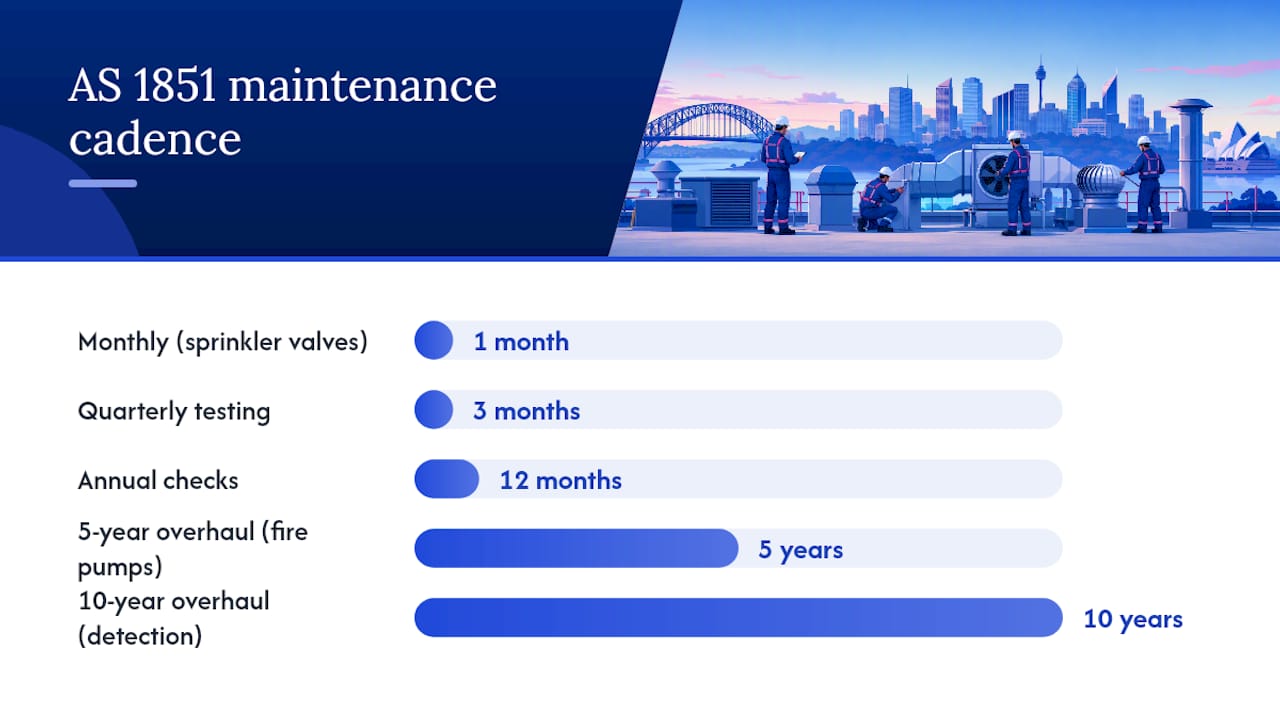
From 13 February 2026, AS 1851-2012 becomes mandatory in NSW for most class 1b and class 2 to 9 buildings required to submit an AFSS. If you own or manage a NSW building in that category, check now whether your existing maintenance contract actually references AS 1851 or an older, informal schedule.
Practical steps worth taking immediately:
- Confirm which standard your current maintenance contract nominates
- Engage a contractor who can demonstrate AS 1851 competency, not just general trade licensing
- Check whether any 5 or 10 year interval items are overdue, since these are easy to miss between annual reports
Pro Tip: Pull your Maintenance Determination or fire safety schedule out and read the actual frequency column against your contractor's invoices. Owners are often surprised to find quarterly testing has quietly slipped to twice a year.
What records you need and how to make them audit ready
Auditors don't take your word for it. They want a paper trail showing the full chain from scheduled task through to verified completion.
Keep these on hand, ideally in both physical logbook and digital form:
- Inspection and test reports for every ESM category, dated and signed
- The current occupancy permit, Maintenance Determination or fire safety schedule
- Contractor licensing and competency certificates
- Defect notices and evidence the defect was rectified, not just logged
A properly compiled contractor report should show the AS 1851 checklist used, classify any defect by severity, and include photographic or written evidence the remedial work was completed and re-tested; managing cleaning contractors efficiently is a practical step to ensure this process runs smoothly. If your current contractor hands over a one-page tick sheet with no defect detail, that's a gap worth closing before an inspector finds it for you. Reviewing electrical inspection records alongside your fire safety files is a useful habit, since electrical faults are a common hidden contributor to ESM failures.
Common pitfalls and a same-day action checklist
Owners tend to fall into the same traps: an ESM list that was never updated after a renovation, a contractor's paperwork that doesn't match AS 1851 categories, or a maintenance schedule no longer matching current law.
Work through this order if you're behind:
- Match your current ESM list against the occupancy permit, item by item
- Check the maintenance schedule frequency against actual contractor visit dates
- Confirm your contractor holds relevant competency, not just a general trade licence
- Rank any open defects by severity and fix critical ones first
- Book overdue 5 or 10 year interval items before they roll into next year's audit
| Priority | Action |
|---|---|
| Critical | Fix defects affecting system function such as alarms and sprinklers promptly |
| High | Reconcile ESM list with occupancy permit without delay |
| Medium | Verify contractor AS 1851 competency soon |
| Ongoing | Schedule overdue long-interval testing before the next report |
How Dualflowservices supports building owners with compliance
A specialist contractor can work with owners on the parts of ESM compliance that often slip through the cracks: keeping logbooks current, coordinating testing schedules with qualified trades, and carrying out remedial electrical, plumbing and heating works once a defect's flagged. If your maintenance records feel patchy or your last audit raised questions, it's worth getting a specialist to walk the building with you before the next report is due.
— Mike
Get compliance sorted before your next report is due
There's a difference between owners who patch things up the week before an audit and owners who never have to think about it, because the maintenance and paperwork are already handled. There are services available that provide an alternative to juggling separate plumbers, electricians and heating technicians for a building's compliance needs in the Mornington Peninsula and surrounding Melbourne suburbs. A coordinated team may cover the plumbing, electrical and heating systems that sit behind essential safety measures, from hot water systems in aged care facilities to switchboards and emergency lighting circuits.
That means one call books the inspection, one contractor's evidence lines up cleanly in your logbook, and defects get quoted and fixed by the same crew that found them, rather than passed between three separate trades. If your ESM records or maintenance schedule need a proper look before your next AESMR or AFSS is due, book a compliance check with Dualflowservices and get it handled before it becomes an infringement notice.
This article is general information, not a substitute for advice from a qualified lawyer. Consult a qualified legal professional about your own circumstances before acting on anything here.
Sources
- Essential safety measures
- Responsibilities of building owners under AS 1851-2012 | NSW Government
- Essential Safety Measures | VIC.GOV.AU
- Essential safety measures | Victorian Building Authority (VBA)