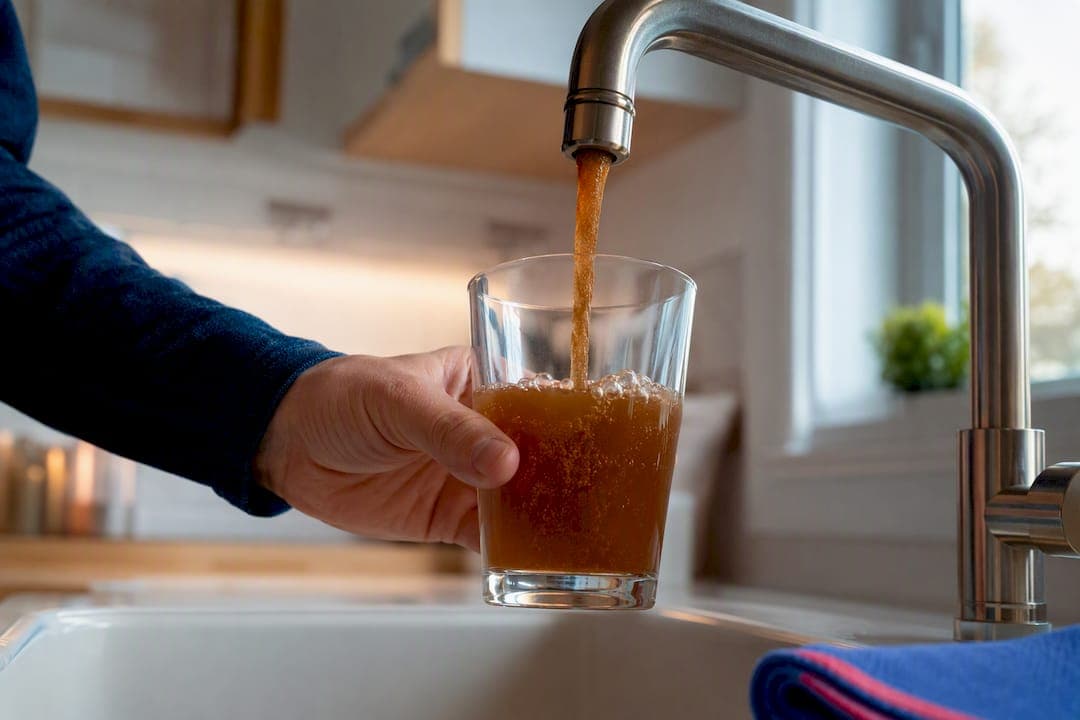
Most brown tap water comes from disturbed sediment, either in the mains outside your house or inside ageing pipes, and it's usually an aesthetic problem rather than a health one. Run the cold tap nearest your main stop valve at a slow, pencil-thin flow for 5 to 20 minutes and leave the hot water alone. If the colour hasn't cleared within 24 hours, or it comes with a strange smell or taste, stop drinking it and get onto your water provider.
TL;DR:
- Most brown tap water results from sediment stirred up in mains or internal pipes, usually resolving within hours after regular flushing.
- Running a slow trickle of cold water for 5 to 20 minutes at the closest outside or kitchen tap often clears discolouration, but stubborn cases may require longer or repeated flushes.
- Persistent or unusual smells and tastes after 24 hours indicate a need to contact your water provider or a plumber to prevent health risks.
- Inside issues like corroding galvanised pipes or sediment buildup in hot water tanks are common causes and may require pipe replacement or tank servicing.
- Regular maintenance such as flushing hot water tanks and replacing anode rods every 8 to 10 years can prevent recurring discolouration issues.
Table of Contents
- What causes brown or rusty tap water?
- Is brown tap water safe to drink?
- What to do right now to clear brown water
- How do you work out where brown water is coming from?
- How do you prevent brown water coming back?
- When should you call your water supplier vs a plumber?
- What a plumber's visit for brown water actually covers
- Get brown water sorted with Dualflowservices
- Sources
- FAQ
What causes brown or rusty tap water?
Brown water almost always traces back to iron or manganese particles getting stirred up somewhere in the system. The trick is figuring out whether that "somewhere" is the street or your own walls.
Outside the property, network disturbances are the usual suspect. A burst main, a firefighting crew using a hydrant, or routine maintenance work can all shake loose sediment that's been sitting quietly in cast iron mains for years. These events tend to resolve within hours because the disturbance passes and the sediment settles again.
Inside the property, the causes are more stubborn:
- Corroding galvanised steel pipes shedding rust into the water supply
- Sediment building up inside a hot-water tank, sometimes made worse by a failing anode rod
- Degraded rubber washers, flexible supply hoses, or tap aerators breaking down and colouring the water
The pattern of the discolouration is your best clue. Water affecting one tap points to a local fitting; water affecting the whole house but clearing at the neighbours' place points to something inside your plumbing rather than the street.
Is brown tap water safe to drink?
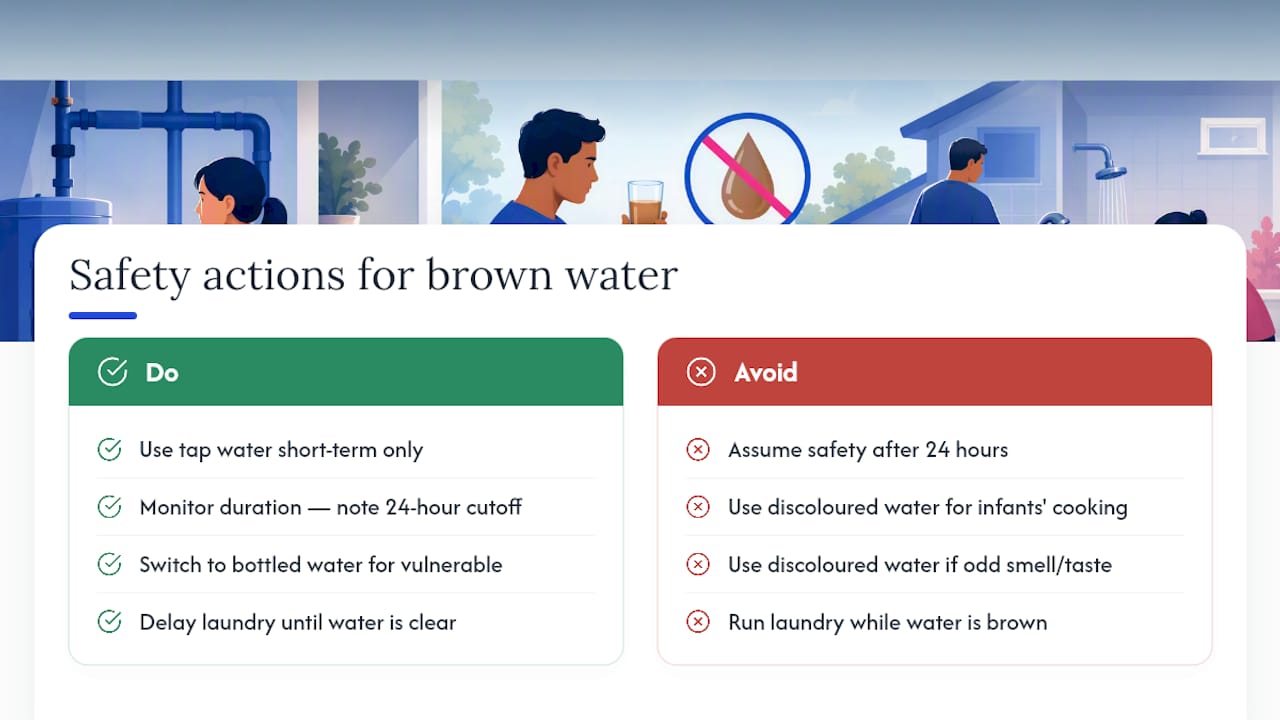
Generally, yes, in the short term. Water authorities describe iron and manganese discolouration as a cosmetic issue rather than a toxicity risk, but that guidance comes with a firm condition: don't assume it's safe if the problem drags on past 24 hours or if you notice an odd smell or taste alongside the colour.
There's a second consideration in older properties. Health guidance on plumbing materials notes that ageing pipes and fittings can introduce contaminants beyond simple rust, which is one reason persistent discolouration deserves more than a shrug. If you've got infants at home, or anyone immunocompromised, switch to bottled water for drinking and cooking until things clear, and hold off on laundry until the water runs clean.
What to do right now to clear brown water
Sort this out with a proper flush rather than blasting every tap in the house at once. High pressure just churns sediment further into your pipes instead of clearing it.
- Find the cold tap closest to your main stop valve, usually an outside tap or the kitchen cold tap.
- Open it to a slow, pencil-thin trickle, not full pressure.
- Let it run for 5 to 20 minutes. Some suppliers suggest longer flushes of 30 minutes to an hour if the sediment is stubborn.
- Check the water. If it's clear, you're done. If not, wait a couple of hours and repeat rather than continuing to run it non-stop.
- Leave hot taps closed throughout. Running hot water during a cold-water event draws sediment into your hot-water tank, turning a short-term nuisance into a long-term one.
Hold off on washing machine loads and dishwasher cycles until the water runs clear, since iron stains on fabric are notoriously hard to shift once set.
Pro Tip: Snap a photo of the discoloured water in a clear glass against a white background, and jot down the exact time. If you end up calling your water provider or a plumber, this detail speeds up diagnosis and gives them something concrete to compare against once the water clears.
How do you work out where brown water is coming from?
A few quick checks at home will usually tell you whether you're dealing with a mains issue, a heater problem, or ageing internal pipes.
- Hot vs cold test: run the hot tap first, then the cold. If only the hot side is discoloured, the problem is almost certainly your water heater, not the street supply.
- Single tap vs whole house: colour at just one fixture points to a local aerator or hose; colour throughout the house points somewhere upstream.
- Ask the neighbours: if their water is clear and yours isn't, the fault sits inside your own plumbing, not the network.
- Inspect aerators and hose bibs: unscrew a tap aerator and look for flakes or grit. Gritty, particle-heavy water is a stronger sign of physical corrosion or a disintegrating tank lining than a smooth, uniform tint.
If you're seeing flakes rather than just colour, or the problem keeps returning after every flush, that's usually a sign of advanced pipe corrosion that a flush alone won't fix, and it's worth getting a plumber to look at the supply pipes and fittings directly.
How do you prevent brown water coming back?
Most recurring brown water traces back to a hot-water tank that's never been serviced. Sediment settles at the bottom of the tank over years, and the anode rod, which is designed to corrode instead of your tank's steel lining, eventually wears out and stops protecting anything.
- Flush the hot-water tank on a regular schedule to clear settled sediment before it becomes a problem.
- Check or replace the anode rod roughly every 8 to 10 years, since a depleted anode lets rust form inside the tank itself.
- Consider an iron or sediment filter if your supply consistently carries high mineral content; a water softener solves a different problem (hardness) and isn't the right fix for iron staining.
- If galvanised pipe is the actual source of the rust, repiping is the only permanent fix: repeated flushing only buys time when the metal itself is corroding from the inside.
- After any brown water event, clean tap aerators and run an empty hot cycle through the washing machine to clear any residue.
Pro Tip: If your home still has original galvanised pipework and you're flushing brown water more than once or twice a year, that's your cue to start budgeting for repiping rather than treating each flush as a one-off fix. Our guide on bathroom plumbing upgrades covers what that typically involves.
When should you call your water supplier vs a plumber?
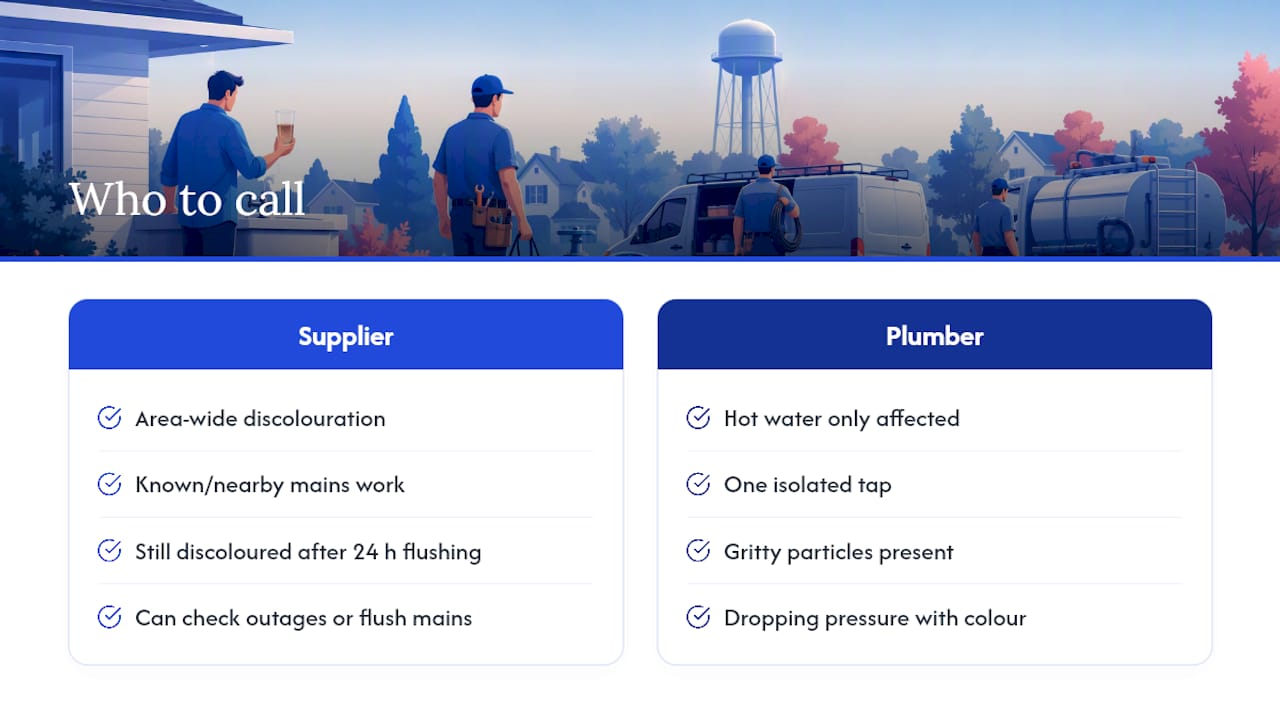
Call your water supplier when the issue looks area-wide, when you know mains work has happened nearby, or when discolouration is still present after 24 hours of proper flushing. They can check for known outages or send a crew to flush the mains on their end if household flushing hasn't cleared it.
Call a plumber when the problem is clearly yours: hot water only, one isolated tap, gritty particles, or dropping water pressure alongside the colour. Have your photo, the time it started, and which taps are affected ready to go. Our emergency plumbing checklist walks through what to note down before you call anyone.
What a plumber's visit for brown water actually covers
A proper diagnostic visit follows a set sequence: isolate the affected line, inspect the hot-water tank's anode rod, test pressure at the affected taps, and check any visible supply pipe and aerators for corrosion. That process usually ends with a clear answer, a straightforward fix recommendation, and a written quote before any work starts.
— Mike
Get brown water sorted with Dualflowservices
A plumber can address the actual cause of brown water rather than just advising continued flushing, whether the issue is a worn anode rod, a hot-water tank needing cleaning, or ageing galvanised pipework.
Our plumbers across the Mornington Peninsula handle emergency call-outs when brown water shows up without warning, plus hot-water system servicing, anode rod inspection and replacement, pipe inspection, and full repiping where the plumbing itself is the problem. Book a diagnostic visit and you'll get a clear answer on what's actually happening, straight-talking advice on whether it's urgent, and a written quote before any work goes ahead. If your home needs bigger changes, like a laundry or bathroom rebuild around old pipework, our partners at Elite Touch Renovations handle that side of things. For everything plumbing related, book a service with Dualflowservices and get it fixed properly the first time.
Sources
- Discoloured water
- Water quality (Power and Water)
- Water appearance | Dŵr Cymru Welsh Water
- ENHealth guidance — lead in drinking water from some plumbing products
FAQ
Is it safe to drink brown tap water?
Usually, yes, since it's typically iron or manganese sediment rather than a toxic contaminant. Stop drinking it and contact your water provider if the colour lasts beyond 24 hours or comes with an unusual smell or taste.
How do I fix brown water coming out of my faucet?
Run the cold tap closest to your main stop valve at a slow trickle for 5 to 20 minutes, without touching the hot water. If it's still discoloured after a few hours, repeat the flush, and if it persists past 24 hours, contact your supplier or book a plumber.
Why is my tap water brown all of a sudden?
Sudden discolouration is most often triggered by nearby mains work, hydrant use, or a burst pipe stirring up sediment in the network. If your neighbours' water is clear and only yours is affected, the cause is more likely inside your own plumbing.
Can I shower if my tap water is brown?
Showering is generally fine since it's not an ingestion risk, though it may stain light-coloured towels or clothing. Avoid running hot water during the event, and hold off on laundry until the water runs clear.