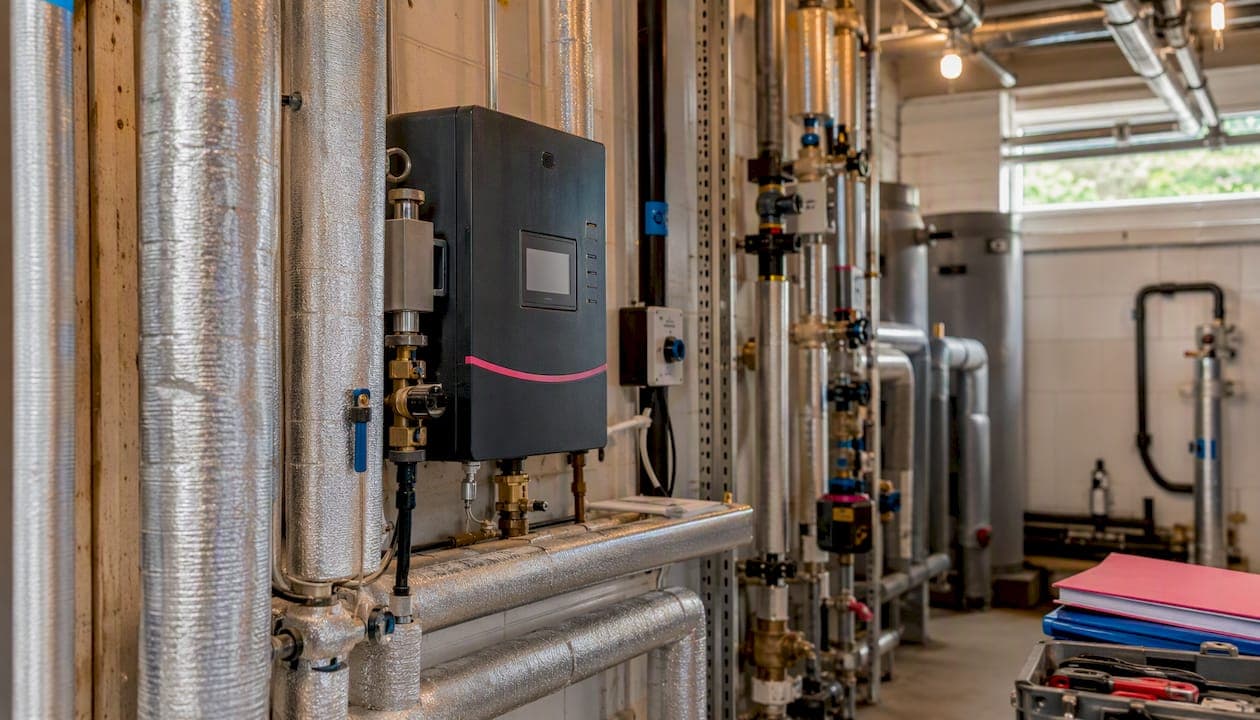
For multi-unit residential buildings and aged-care facilities in Australia, centralised hot water systems genuinely deliver lower maintenance costs, simpler compliance, and a cleaner upgrade path to heat pumps and solar — but only when they are correctly designed, properly commissioned, and actively managed.
The headline gains:
- Lower collective maintenance cost: one plant to service instead of 20, 50, or 100 individual units
- Central control and easier compliance: single access point for inspections, temperature management, and regulatory checks
- Energy and carbon savings: scale advantages make central heat pump water heaters (CHPWHs) and solar-boosted systems more practical than per-unit alternatives
- Space reclaimed in dwellings: no hot water cylinder on the balcony or in the laundry cupboard
- Simpler upgrade path: replacing one central plant is far less disruptive than retrofitting every apartment
The main caveat: these benefits depend entirely on correct sizing, adequate pipe insulation, and a maintenance programme that treats the plant as critical infrastructure. A poorly designed or neglected centralised system can cost more and perform worse than individual units.
Key takeaways
Centralised hot water systems deliver real financial and operational benefits for Australian multi-unit and aged-care buildings, but only when correctly designed, commissioned, and actively maintained.
| Point | Details |
|---|---|
| Size threshold matters | Jemena's design guide identifies roughly a medium to large number of stacked apartments as the threshold where centralised systems become cost-competitive. |
| CHPWH efficiency advantage | Properly designed central heat pump systems can be three to four times more efficient than electric resistance water heaters. |
| CF/GCF is your benchmark | Demand CF/GCF calculations from every supplier; these are the primary metrics for verifying a centralised gas system will match individual-unit efficiency. |
| Commissioning is non-negotiable | A documented commissioning report with measured performance data is the only way to confirm the promised benefits have been achieved. |
| Governance protects residents | OC contracts with third-party operators must include audit rights, transparent billing, and clearly priced exit terms to prevent vendor lock-in. |
Table of Contents
- What is a centralised hot water system?
- What are the real benefits of centralised hot water systems?
- How does a centralised system actually save money and energy?
- What design risks should you control before signing off?
- Who owns the plant and how are residents billed?
- What are the real disadvantages and how do you mitigate them?
- Is a centralised hot water system right for your building?
- What do centralised systems cost and what drives payback?
- Maintenance and compliance for aged-care and multi-unit facilities
- Australian case summaries: when centralised systems work well
- How to evaluate suppliers and the 12 questions you must ask
- A practical perspective from Dualflowservices
- Sources
What is a centralised hot water system?
A centralised hot water system heats water in a single plant room and distributes it to every dwelling via insulated pipes and a continuous hot water circulation (HWC) loop. Residents draw hot water from the loop rather than from an individual storage unit inside their apartment.
Core components:
- Central heater(s): gas boilers, central heat pump water heaters (CHPWHs), or solar-boosted collectors
- Buffer storage: insulated tanks that smooth peak demand and allow off-peak or solar charging
- HWC loop: a continuous recirculating pipe that keeps hot water available at every tap without long wait times
- Distribution pipework: insulated risers and branches connecting the plant room to each dwelling
- Heat interface units (HIUs) or sub-meters: installed at each dwelling to measure consumption and, in HIU configurations, to isolate the unit's draw from the shared loop
Common variants in Australian multi-unit buildings:
- Gas centralised: one or more gas condensing boilers feeding a shared loop; the most common existing configuration in mid-rise and high-rise buildings
- Central heat pump water heater (CHPWH): electric heat pumps at scale, often significantly more efficient than electric resistance systems; increasingly the preferred upgrade path
- Solar-boosted central systems: rooftop solar thermal collectors or PV with a solar diverter feeding into the central storage, with gas or heat pump backup
What are the real benefits of centralised hot water systems?
Financial benefits
The Jemena design guide recommends centralised gas systems for buildings of roughly a medium to large number of stacked apartments, where the per-dwelling capital and maintenance costs become competitive with individual units. Below that threshold, the economics are less clear.
Pooled capital means one plant purchase instead of dozens. When a large apartment building replaces individual electric storage systems, the owner's corporation (OC) buys one central system rather than coordinating 60 separate replacements at unpredictable intervals. Bulk servicing contracts, single-point warranty management, and fewer emergency call-outs per year all reduce lifecycle cost.
Operational benefits
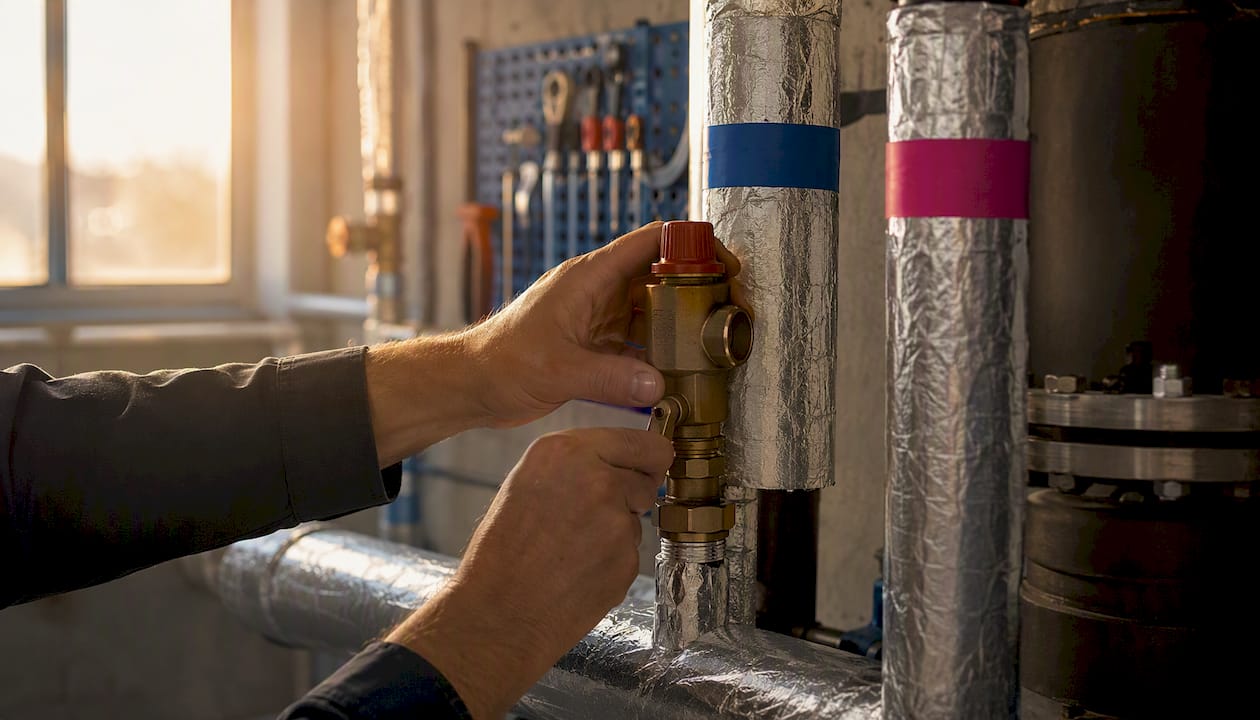
Plant located outside dwellings means a technician can service, inspect, or repair the system without entering any apartment. For aged-care facilities and retirement villages, that matters enormously: residents are not disturbed, infection-control protocols are easier to maintain, and compliance inspections happen on the building's schedule rather than the resident's. Centralised systems free in-unit space and centralise maintenance access, with HIUs or sub-metering preserving resident control and enabling fair billing.
Energy and carbon benefits
At scale, a CHPWH system can be three to four times as efficient as electric resistance water heaters when properly designed and commissioned. That efficiency gap is nearly impossible to achieve with per-unit heat pumps in apartments where space, noise, and airflow are constrained. Solar-boosted central systems and solar diverters can substantially reduce running costs and emissions compared with conventional electric storage.
Space and resident amenity
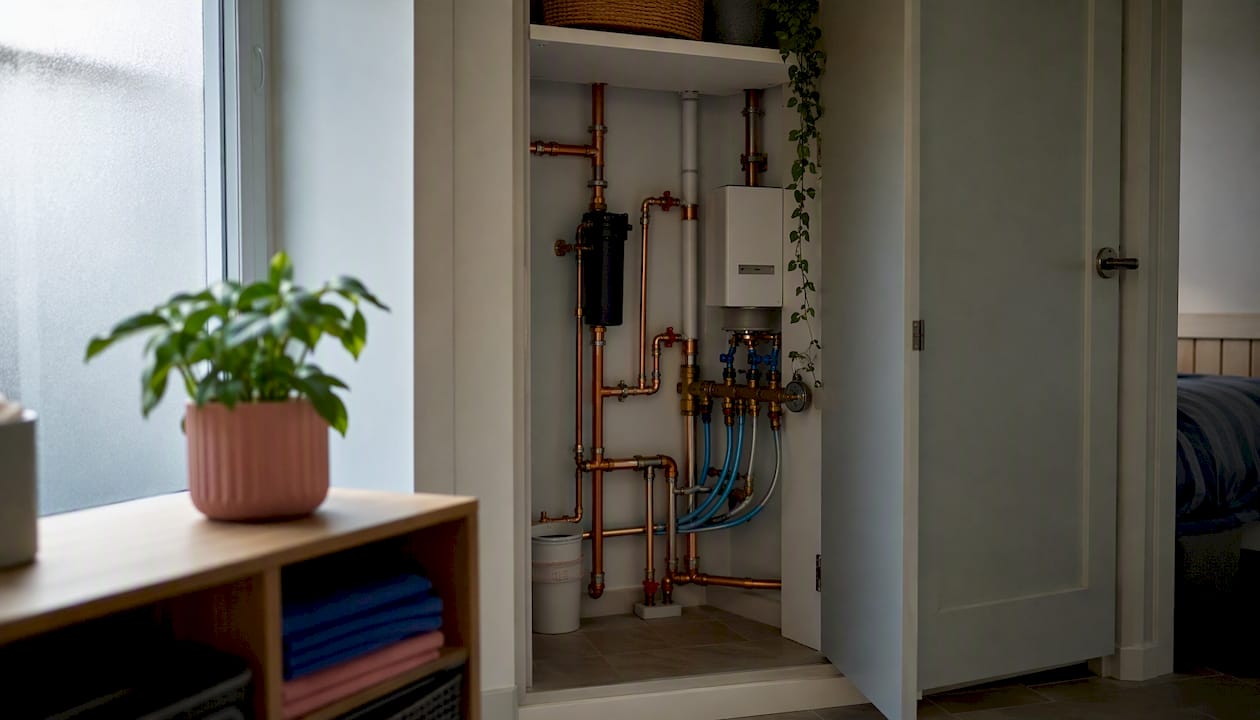
Removing the hot water cylinder from each dwelling reclaims storage space, eliminates the noise of individual units cycling on and off, and removes a maintenance liability from inside the apartment. For disability care homes and aged-care facilities, that space can be repurposed for accessibility equipment or simply reduces clutter in already compact rooms.
Pro Tip: Preserve resident control by specifying HIUs with individual meters at each dwelling. Residents who can see their own consumption tend to use less hot water, and fair billing based on actual use reduces disputes with the OC.
How does a centralised system actually save money and energy?
Economies of scale
Larger plant operates more efficiently. A gas condensing boiler serving 40 apartments runs closer to its design efficiency than a small individual unit cycling on and off for a single dwelling. For CHPWHs, the coefficient of performance (COP) at scale is higher because the heat pump can be sized to operate in its optimal range rather than oversized for a single-unit worst case.
Buffer storage, off-peak charging, and solar boosting
Buffer storage tanks allow the plant to charge during off-peak tariff periods or when solar generation is high, then draw down during morning and evening peaks. The PNNL resource guide explains that storage-led strategies let CHPWHs operate during low-cost periods, smoothing grid impact and lowering operating costs. Solar diverters and PV integration can make central electric storage act as a battery for surplus solar, though switching from controlled-load tariffs to general supply has tariff implications that must be modelled before committing.
HWC loop heat loss: the hidden cost
The HWC loop keeps hot water available at every tap, but it also loses heat continuously through the pipe walls. Poorly insulated reticulation in a large building can consume a significant share of total heating energy just maintaining loop temperature. Pipe insulation to AS/NZS 4859.1 standards, well-designed return strategies, and properly calibrated circulation pump controls are the primary levers for containing this loss.
CF/GCF benchmarking
The Jemena design guide defines the Common Factor (CF) and Generalised Common Factor (GCF) as benchmark performance indicators for gas centralised systems. These metrics compare the energy consumed by the centralised system against a reference individual-unit system. Designers should meet Jemena's target CF/GCF values to confirm the centralised system is at least as efficient as the individual units it replaces. If a supplier cannot provide CF/GCF calculations, that is a red flag.
Pro Tip: When reviewing supplier proposals, ask for the CF/GCF calculation, the expected COP for any heat pump plant, storage sizing rationale, and estimated standby losses. A supplier who cannot produce these numbers has not done the design work.
What design risks should you control before signing off?
Sizing: the most common mistake
Oversized plant short-cycles, reducing efficiency and accelerating wear. Undersized plant cannot meet peak demand, leading to resident complaints and emergency call-outs. Correct sizing requires a load analysis based on actual dwelling count, occupancy patterns, and peak simultaneous demand, not a rule-of-thumb multiplied by apartment count.
HWC loop design and insulation
The loop must be designed so that every dwelling receives water at the required temperature within a few seconds of opening a tap. That requires correct pipe sizing, balancing valves, and insulation along every metre of distribution pipework. Skimping on insulation at installation is one of the most common causes of high operating costs and resident complaints about lukewarm water.
For hydronic and hot water circulation design in large facilities, the principles of loop balancing and insulation specification apply directly to centralised hot water plant.
Storage strategy
Storage size affects short-cycling risk for heat pumps, peak delivery capacity, and the ability to shift load to off-peak periods. The PNNL guide notes that CHPWH systems require careful separation of primary DHW heating and HWC temperature maintenance loads, with storage and multi-pass or single-pass configurations chosen to match building usage patterns.
Noise, plant location, and acoustic requirements
Central plant, particularly CHPWHs, generates noise. Roof-mounted or external plant rooms are common, but in aged-care and residential settings, acoustic treatment is not optional. Vibration isolation, acoustic enclosures, and careful siting away from bedroom walls are standard requirements. The PNNL guide flags equipment size and noise as key considerations for roof- or externally-mounted systems.
Commissioning
Factory-packaged or skid-mounted systems reduce installation risk because components arrive pre-assembled with clear installation documentation, lowering the chance of on-site design errors. Custom-built systems require more rigorous commissioning to verify that every component performs to specification. Either way, a commissioning report with measured performance data is non-negotiable before handover.
Design review checklist:
- Load analysis documented and signed off by a qualified engineer
- CF/GCF targets specified and verified in design drawings
- Pipe insulation specification referenced to AS/NZS 4859.1 or equivalent
- Storage sizing calculation provided with peak demand assumptions stated
- Acoustic assessment completed for plant location
- Commissioning plan included in contract scope
- Re-commissioning trigger points defined (e.g. after major works or change of occupancy)
Who owns the plant and how are residents billed?
Owner's corporation (OC) owned and maintained
The OC owns the plant, funds capital replacement through the sinking fund, and contracts maintenance directly. Residents pay a levy that covers their share of operating costs. This model gives the OC full control over service quality and billing transparency, but requires governance capacity to manage contracts and respond to faults.
Embedded network / third-party operator
A specialist operator (such as Active Utilities or Locality Energy) owns or manages the plant and bills residents directly for consumption. The OC avoids capital outlay and day-to-day management, but industry commentary warns that poor oversight and "set-and-forget" management commonly turn centralised plant into a cost and service liability. Vendor lock-in is a real risk: long exclusive contracts without audit rights or exit pricing can leave the OC with little leverage if service quality deteriorates.
Sub-metering and HIU billing
Sub-meters or HIUs at each dwelling measure individual consumption and enable per-unit billing. Metering at the HIU level maintains resident control and enables behaviour-driven savings, but metering accuracy and audit rights must be contractually guaranteed. Meters drift over time; without a contractual right to independent audit, residents have no way to verify their bills.
| Model | Control | Transparency | Capital required | Resident impact |
|---|---|---|---|---|
| OC owned | High | High | High upfront | Levy-based, fair |
| Third-party operator | Low | Variable | Low/nil | Direct billing, lock-in risk |
| Sub-metered / HIU | High | High | Moderate | Individual billing, behaviour savings |
Pro Tip: Any embedded network or third-party operator contract should include: measurable service level KPIs, an independent meter audit right at least every two years, transparent cost-of-supply disclosure, and clearly priced exit terms. Without these, the OC has no practical recourse.
What are the real disadvantages and how do you mitigate them?
Centralised systems have genuine downsides. Knowing them in advance lets you write mitigations into contracts and design briefs before problems emerge.
Thermal losses from the HWC loop. A poorly insulated or poorly commissioned loop can lose a substantial share of heating energy just maintaining temperature. Mitigation: specify insulation standards in the design brief, require measured loop losses at commissioning, and include loop performance as a KPI in maintenance contracts.
Vendor lock-in and opaque billing. Third-party operator arrangements can leave residents paying above-market rates with no visibility into cost components. Mitigation: insist on audit rights, transparent cost-of-supply disclosure, and exit pricing in any operator contract.
Reduced resident control. Residents cannot adjust their hot water system independently. If the plant goes down, every dwelling is affected simultaneously. Mitigation: HIUs give residents some local control; clear communication protocols and fast response SLAs in maintenance contracts reduce the impact of outages.
Legionella and scalding risk. Centralised systems that are not maintained to schedule can develop legionella in storage or distribution pipework. Scalding risk increases if thermostatic mixing valves (TMVs) are not correctly set and regularly tested, particularly in aged-care settings. Mitigation: regular hot water system flushing, temperature management protocols, and scheduled TMV testing are non-negotiable for facilities with vulnerable occupants.
Noise and space. Central plant takes up space and generates noise. Mitigation: acoustic treatment, vibration isolation, and careful siting during design, not as an afterthought.
Is a centralised hot water system right for your building?
Use this checklist to decide whether to commission a formal feasibility study.
Building characteristics (strong indicators for centralised):
- 15 or more stacked apartments (the threshold the Jemena design guide identifies for cost competitiveness)
- Existing central plant room or roof space suitable for plant
- High and consistent occupancy (aged care, build-to-rent, student accommodation)
- Access to controlled-load tariffs or on-site solar generation
Operational readiness:
- OC or facility management team with capacity to manage a maintenance contract
- Governance structure that can enforce service level KPIs and audit rights
- Appetite for capital investment in exchange for lower lifecycle costs
Financial triggers:
- Existing per-unit systems approaching end of life (replacement decision imminent)
- Payback horizon of 7–15 years acceptable to the OC or owner
- Willingness to invest in metering and commissioning upfront
Decision guidance:
- If you tick most of the building and operational boxes, commission a feasibility study from a qualified building services engineer before approaching suppliers.
- If building size is below 15 apartments or occupancy is low and variable, individual heat pump units or solar-boosted systems may deliver better value.
- If existing plant is mid-life and performing adequately, plan the upgrade now but execute at end of life.
- If you are in aged care or disability care, treat the feasibility study as mandatory, not optional, given the compliance and resident safety implications.
What do centralised systems cost and what drives payback?
Capital cost components
Capital costs cover the central plant (boilers, heat pumps, or solar collectors), buffer storage tanks, distribution pipework, insulation, HIUs or sub-meters at each dwelling, controls, and commissioning. For a CHPWH upgrade in a mid-rise building, the plant and storage typically represent the largest share, with metering and commissioning adding meaningful cost that is often underestimated in early budgets.
Operating cost drivers
Running costs are shaped by fuel or electricity tariff, standby losses from the HWC loop, circulation pump energy, and the maintenance contract. Buildings with access to controlled-load tariffs or significant on-site solar generation can materially reduce operating costs by shifting heat pump operation to low-cost periods.
What drives payback time
Payback is faster when:
- The building is large (more dwellings sharing fixed plant costs)
- Occupancy is high and consistent
- The system integrates with solar or off-peak tariffs
- The existing per-unit systems being replaced are inefficient electric resistance units
Payback is slower when:
- The building is small or occupancy is variable
- The HWC loop is poorly insulated (high standby losses)
- The operator contract includes margin that inflates running costs
Questions to ask in supplier quotes
- What is the CF/GCF for the proposed design, and how does it compare to Jemena's target values?
- What COP is assumed for heat pump plant, and under what ambient temperature conditions?
- What is the baseline cost comparison to existing per-unit systems (capital and operating)?
- What are the warranty terms and expected lifecycle costs over 15 and 25 years?
- What are the standby loss assumptions and how are they validated at commissioning?
Pro Tip: Ask every supplier for a worked example covering one representative dwelling: annual hot water cost, share of HWC loop losses, and total plant operating cost divided by dwelling count. If suppliers use different assumptions, this exercise makes the differences visible and comparable.
Maintenance and compliance for aged-care and multi-unit facilities
Treat the centralised hot water plant as critical infrastructure. In aged-care and disability care settings, a hot water failure is not an inconvenience, it is a safety and compliance event. Heating system breakdowns put residents at genuine risk, and the consequences of a lapse in a care setting are far more serious than in a standard apartment block.
Recommended service cadence
- Daily: visual checks on plant room (pressure, temperature, alarm status) by facility staff
- Monthly: circulation pump checks, temperature verification at sentinel outlets, TMV function check
- Quarterly: full system flush of low-use outlets, legionella risk assessment review, filter and strainer inspection
- Annual: full commissioning review, storage tank inspection, insulation condition check, meter calibration verification, re-commissioning if performance has drifted
Hygiene controls
Legionella risk management requires maintaining storage temperatures above 60°C and distribution temperatures above 50°C at all outlets, with TMVs set to deliver safe mixed temperatures at point of use. For aged-care facilities, the winterising and seasonal readiness guide covers additional cold-weather checks that apply to hot water plant as well as heating systems.
Commissioning and re-commissioning
Operational success depends on a documented commissioning report with measured performance data. Industry commentary is clear: owners should retain commissioning reports and require periodic re-commissioning after major works to preserve CF/GCF performance. A system that was efficient at handover can drift significantly if controls are not recalibrated after modifications.
Service contract requirements
Maintenance contracts for aged-care and multi-unit facilities should specify:
- Maximum response times for emergency call-outs (e.g. 4 hours for total loss of hot water in a care facility)
- Spare parts policy (critical parts held on-site or within 24-hour delivery)
- Documented service records accessible to the OC or facility manager
- Annual performance report against CF/GCF and COP targets
- Escalation procedure for legionella or scalding incidents
Pro Tip: Before handing over a centralised plant to a new aged-care operator or facility manager, run a structured induction: walk through the plant room, explain the alarm system, demonstrate the emergency isolation procedure, and provide a laminated quick-reference card for daily checks. Staff turnover in care settings is high; the card stays even when the person who was trained leaves.
Australian case summaries: when centralised systems work well
Mid-rise apartment block: CHPWH upgrade
A 48-apartment building in metropolitan Melbourne replaced ageing individual electric storage units with a central heat pump water heater system with buffer storage and off-peak charging. The key outcome was a reduction in per-dwelling hot water energy costs, driven by the COP advantage of the central heat pump over the old resistance elements and the ability to charge during off-peak tariff periods. The lesson: the upgrade economics were only viable because the building had a suitable plant room and consistent high occupancy. Buildings with lower or variable occupancy would have seen a longer payback.
Aged-care facility: gas centralised with solar boosting
A residential aged-care facility in regional Victoria operated a gas centralised system with solar thermal boosting. The central plant allowed maintenance staff to manage the entire hot water system from one location, simplified legionella risk management, and freed space in resident rooms previously occupied by individual units. The lesson: for aged care, the operational and compliance benefits often justify the system even before the energy savings are counted.
Poor design outcome: undersized storage, high loop losses
A 30-apartment building installed a centralised system with undersized buffer storage and inadequate pipe insulation. Residents experienced lukewarm water during morning peaks, and the OC faced higher-than-expected energy bills because the HWC loop was losing heat through uninsulated sections in the car park. The corrective action was a re-commissioning exercise, additional insulation, and a storage upgrade. The lesson: commissioning and insulation are not optional extras; they are where the promised benefits are either realised or lost.
How to evaluate suppliers and the 12 questions you must ask
Supplier selection criteria
Look for suppliers with documented design capability (not just installation experience), a commissioning track record with measured performance data from comparable projects, local maintenance capability, and warranty terms that cover both plant and workmanship. For aged-care and multi-unit projects in Victoria, local support matters: a supplier based interstate cannot provide a 4-hour emergency response.
For guidance on commercial plumbing maintenance frameworks and what to expect from a service contract, the principles apply directly to centralised hot water plant.
12 questions to ask every supplier
- What is the CF/GCF for your proposed design, and does it meet Jemena's target values?
- What COP do you assume for heat pump plant, and at what ambient temperature?
- Can you provide commissioning reports from three comparable completed projects?
- What are the standby loss assumptions, and how are they measured at commissioning?
- What storage sizing methodology did you use, and what peak demand assumptions underpin it?
- What are your SLAs for emergency response, and are they contractually binding?
- What is your spare parts policy for critical components?
- Do residents or the OC retain independent meter audit rights, and at what frequency?
- What are the exit terms if the OC wishes to change operator or bring maintenance in-house?
- What acoustic mitigation is included in the design, and has it been independently assessed?
- Can you provide client references from aged-care or multi-unit projects of similar scale?
- How does the system integrate with on-site solar or controlled-load tariffs, and what tariff modelling have you done?
Checklist for validating supplier claims:
- Request design calculations, not just summary figures
- Ask for as-built drawings from a comparable project
- Verify COP claims against manufacturer data sheets at the relevant ambient temperature
- Contact at least two client referees independently
Pro Tip: Red flags in supplier responses: no CF/GCF calculation, vague metering arrangements ("we'll sort that out at installation"), exclusive contracts longer than five years without audit rights, and COP claims that do not reference ambient temperature conditions. Any of these should prompt a request for clarification before proceeding.
A practical perspective from Dualflowservices
The most consistent pattern in centralised hot water projects that go wrong is not a technical failure. It is a governance failure: an OC or facility manager who accepted a proposal without demanding the design metrics, signed a contract without audit rights, and then had no leverage when performance fell short. The technology works. The economics work, at the right building scale. What breaks down is the oversight.
For aged-care and disability care operators, the stakes are higher still. Hot water is not a comfort amenity in those settings; it is a hygiene and safety requirement. A plant that is not maintained to schedule, or a HWC loop that is losing heat through uninsulated pipework, creates real risk for residents who cannot advocate for themselves.
Dualflowservices provides maintenance, commissioning, and emergency support for centralised hot water systems across the Mornington Peninsula and surrounding Melbourne suburbs, with specific experience in aged-care, retirement villages, and disability care homes. If you are evaluating a new system, planning an upgrade, or managing an existing plant that is not performing as expected, contact Dualflowservices for a site assessment.
Sources
These are the primary technical references to consult when evaluating proposals or commissioning work.
- Design guide for gas centralised hot water systems — Jemena
- Central heat pump water heaters for multifamily buildings — Building America Solution Center (PNNL)
- Centralised hot water systems — Inside Strata (industry commentary)
- Hot water guide — 100% Renewables
- 6 benefits of centralised hot water systems — Antares